




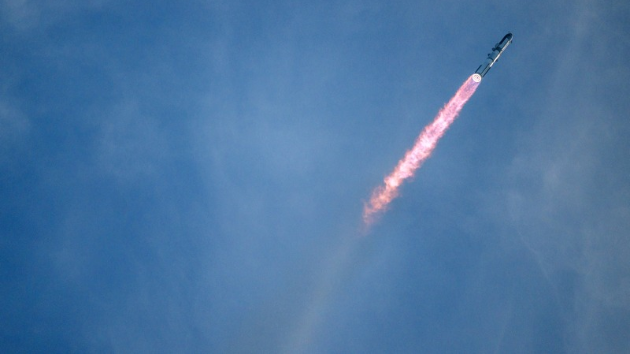
Imagine if every time you flew somewhere, the airline had to throw away the plane when you landed and replace it with a new one. Or if your car was only good for one trip.
As absurd as that sounds, SpaceX CEO Elon Musk told the audience at the X Takeover 2025 event that's how it goes for rocket launches.
"If every time you drove somewhere you had to throw away the car, you'd be 'wow' that's a crazy car where you have to throw away after every time you drive it. But that's how it works for rockets," Musk told the crowd.
Or that's how it used to work. Blue Origin and SpaceX, along with a growing number of new rocket companies, are developing fully reusable space launch systems that could fundamentally change the economics and sustainability of space missions.
"The cheap part of a launch, relatively speaking, is the fuel. And so being able to do reusability, particularly quickly, with a minimum of refurbishment, allows you to really drive down the cost of launching things into space and allows you to increase the amount of stuff you can send into space, which SpaceX has really been leaning into," Casey Dreier, chief of space policy at The Planetary Society, told ABC News.
But to get there, SpaceX has to demonstrate that both stages of Starship, the world's largest and most powerful rocket and spacecraft, can return to the launch site and be captured by the tower's giant robotic "chopsticks."
"This is a massive rocket, and so to be able to catch it is a huge point of demonstration and a critical step along their goal of reusability and rapid reusability, which is in a sense key to all of their future plans," said Dreier. "They need to be able to turn these launches around within a couple of days, if not a day, and that doesn't happen without catching the rocket."
If the weather and the vehicles cooperate, SpaceX will attempt to achieve that milestone for the first time on Friday at 5:45 p.m. ET, when it launches Starship for the 15th time from its Starbase launch site in Cameron County, Texas. The company has 75 minutes to get the rocket off the pad before it has to scrub.
"You're building this incredibly complicated, expensive machine, and then you just discard it. So why not find a way to reuse it and then be able to launch it several times," said Austin Spiegel, a former SpaceX engineer and now the CEO of Sift, which helps rocket companies capture and analyze test data.
Musk often reminds people that "rockets are hard," but Spiegel says Musk also has a saying for why making them reusable is even harder.
"It's like trying to land a toothpick in a hurricane," said Spiegel.
The mission will begin like the previous Starship flights. The combined 407-foot Super Heavy booster and Starship spacecraft will lift off from the pad, and about six minutes later, the first-stage booster will return to the launch site for the tower's mechanical arms to attempt a catch. While this is something SpaceX has done three times with a previous generation booster, it will be the first for the latest version.
Starship will then deploy 26 Starlink V3 satellites, adding capacity to SpaceX's orbital communications network.
During the mission, Starship will orbit Earth about 14 times during its more than 22-hour flight, with SpaceX monitoring the vehicle's health throughout. The company says its flight profile gives it several opportunities to deorbit early over the ocean if any problems arise.
If all goes well and the vehicle's systems are healthy, the big moment will come Saturday afternoon around 4:15 p.m. ET, when Starship returns to the launch pad after a deorbit burn and then, for the first time, SpaceX will attempt to catch it using the launch tower's robotic "chopsticks." And if both catches are successful, Starship will become the first fully recovered orbital rocket in history.
But a successful Flight 15 doesn't mean the company is about to turn spaceflight into something as routine as commercial airline flight.
Dreier says the biggest hurdle for SpaceX in making Starship a rapidly reusable spacecraft is the vehicle's heat shield, the tiles that keep the vehicle from burning up in the atmosphere during reentry.
"You have a lot of heat to dissipate when you bring something that big back down to Earth," explains Dreier. "You have to have these big tiles on it, and you want to make sure those are able to be both examined relatively quickly to make sure there are no cracks in them and then repaired very quickly so you don't have to spend months going through them piece by piece to try to ensure that it's ready for flight."
Musk has acknowledged that developing a heat shield capable of rapid reuse is a considerable engineering challenge, as it's never been done before.
"I think the lesson has been to not bet against SpaceX, particularly on these engineering issues. If any company can do it, it will be this company," said Dreier.
Copyright © 2026, ABC Audio. All rights reserved.